Bonita Springs, FL · Garage Door Service
Golden Gate homes cluster around 1986-built steel colonial-panel doors. We match discontinued panel profiles and haul the right stock 13 miles from Bonita Springs.
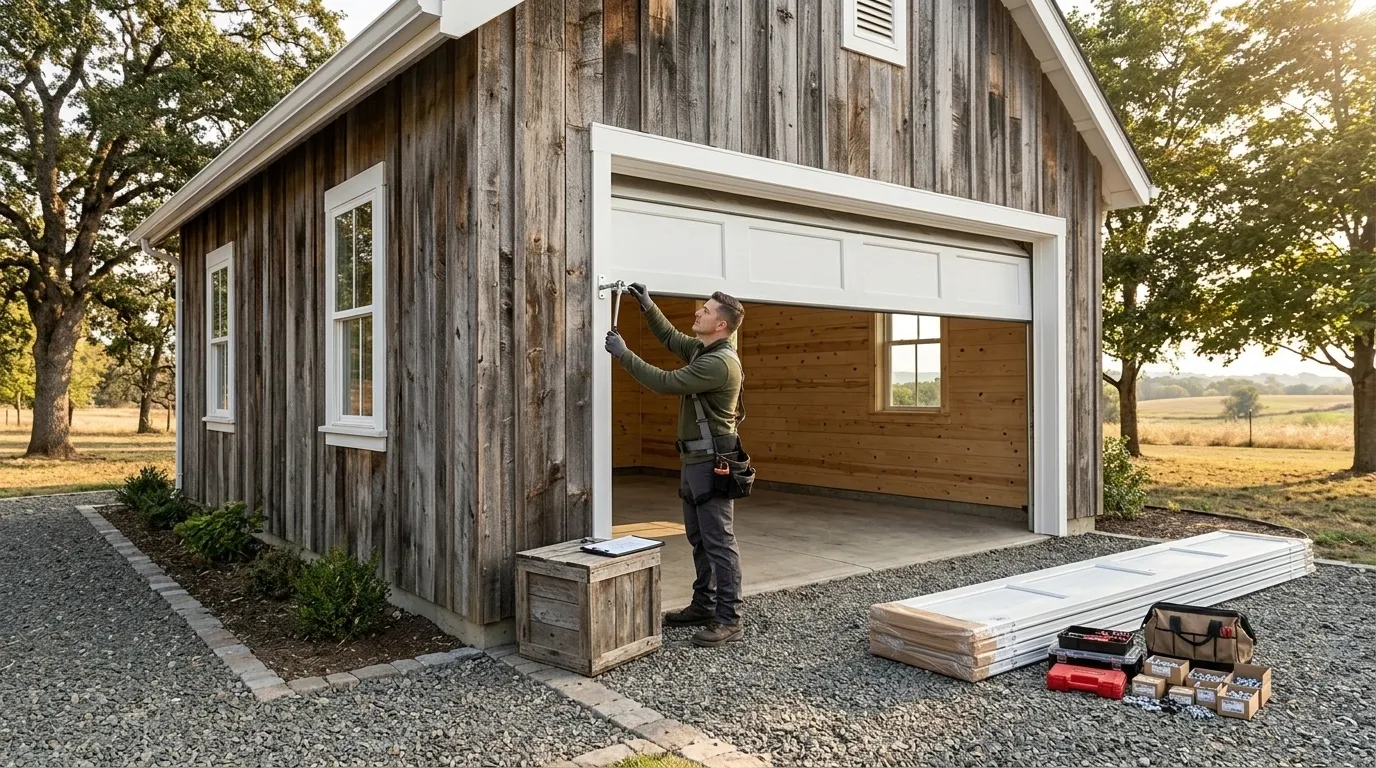
What you pay for a panel swap in Golden Gate depends on what's actually on the door, and most doors here tell the same story: steel colonial-panel sections put up somewhere between 1979 and 2007, with 1986 as the middle of that run. That means raised-panel embossing, not the flat smooth stock that's standard on new builds, and it means finding a matching section isn't always a same-day errand. Household income across Golden Gate runs closer to $64,767, noticeably under the $92,575 median we see across the wider service area we cover out of Bonita Springs. That gap shows up in the calls we get - more single-panel patch jobs here, fewer full-door replacements, because a homeowner would rather fix the dented section than swap the whole door if the rest of it still tracks straight. We'll tell you flat out when a patch makes sense and when it doesn't. A single replacement panel on a door that's already delaminating at the bottom section is money that should've gone toward the whole door instead.
The complaint is almost always the same shape: a car backed into the bottom section, a basketball dent from the driveway, or a section that's started to bow and separate at the seam. On the colonial-panel steel doors common to Golden Gate's 1986-era stock, that bowing often means the panel's rigid foam backing has broken loose from the skin - you'll hear it flex or drum when the door moves, even before you see daylight through the seam. On the fiberglass-and-wood-composite panels sold through the late '80s and into the '90s, the failure looks different: swelling at the bottom rail, soft spots where water's worked in over the years, sometimes a crack running the length of a raised panel. Either way, one bad section usually means the door is out of balance, and a door that's out of balance puts extra load on the opener and the springs every time it runs. If you're only fixing the panel that's visibly wrecked, ask us to check the rest of the door while we're there - a hairline crack two sections up doesn't announce itself the way a dent does.
Golden Gate sits about 13 miles out from our Bonita Springs shop, so we plan a panel job as one trip, not two. That means we bring the replacement section and the matching hardware - end stiles, matching color coat, correct fastener spacing for that era of door - on the same run, since there's no local depot here to double back to if we guessed wrong on the profile. A single-section swap on a standard double door usually runs a couple of hours once we're on site, assuming the panel is in stock in the right color and profile. The wait is almost never in the labor. It's in sourcing a colonial-panel steel section that matches a door built when 1986 was the standard build year, because that exact embossing pattern isn't something every supplier racks. We'd rather tell you the panel's on order for a few days than show up with a close-enough match that leaves a visible seam line down the door.
The complication with Golden Gate's housing stock isn't the climate - the mild temperate band here spares doors the freeze-cracking that ruins panels up north. It's age and materials working together. A steel panel from the 1986 build window is usually galvanized but thin-gauge by today's standard, and after three-plus decades of Southwest Florida humidity and sun, the paint's chalked and the seams have started to separate even where there's no dent. Matching a single new panel to five faded original ones almost never looks seamless - the color's close but not identical, and the new section's embossing can sit slightly deeper than the sun-worn originals. We'll match as close as the supplier stocks and say so upfront. The other issue: some of these doors used section heights and end-stile spacing that later manufacturers changed. If the model's been discontinued, we may need a universal-fit panel trimmed to match rather than an exact factory replacement, and that's a conversation we have before we order, not after.
Panels fail here for reasons tied directly to when Golden Gate was built. With roughly 8,100 households in the area, most sharing that same 1979-2007 window and clustering around 1986, the door hardware and panel stock across the neighborhood is remarkably uniform - which means the same section width, the same discontinued embossing pattern, and often the same failure point shows up house after house. Steel panels from that era were built thinner than what's sold today, so they dent easier and, once dented, the foam-and-skin bond doesn't hold as well as it once did. Add three decades of sun exposure and the color coat on most of these doors has gone chalky, which is part of why a fresh panel next to five faded ones is never invisible. This isn't a defect specific to any one house - it's the era. A door built in 1986 was built to the standards and materials of 1986, and nobody expected it to still be running unmodified in the 2020s.
For panel jobs in this part of the service area we carry steel colonial-panel sections in the common widths and colors that match the 1980s-90s build stock, plus end stiles, matching fasteners, and touch-up coating for color blending. We also carry universal-fit sections for the cases where the original manufacturer's exact profile is discontinued - it's not a perfect match, but trimmed and hung right, it holds up and closes the gap. What we don't carry, and won't pretend to, is an exact factory match for every embossing pattern ever run in that era; some of those molds haven't existed in years. If your door needs one, we'll say so rather than sell you a section that looks wrong from the driveway. For repairs beyond a single panel - spring, track, or opener work - that's a separate call, and we cover that side of things on our Golden Gate repair page, not here.
Not usually, if the door is original to the 1979-2007 build stock common in Golden Gate. Paint fades and embossing wears over 30-plus years, so a fresh panel next to older ones is close in color but rarely identical. We'll show you the swatch before we order so you know what to expect.
Depends on the door's overall condition. If the rest of the sections track straight and aren't delaminating, one panel is usually the cheaper fix. If two or more sections are already bowing or the door's out of balance, patching one panel just delays a full-door job you'll pay for anyway.
We carry the common steel colonial-panel widths and colors from that era, plus universal-fit sections for discontinued profiles. An exact factory match for every embossing pattern from the 1980s and 90s isn't always available - we'll tell you straight if yours is one of those cases.
About 13 miles from our Bonita Springs location. We don't run a branch or depot in Golden Gate itself, so panel jobs are planned as a single trip - we bring the section and matching hardware with us rather than making a return run.
Call now or request a free quote - same-day service on most repairs, upfront written pricing.